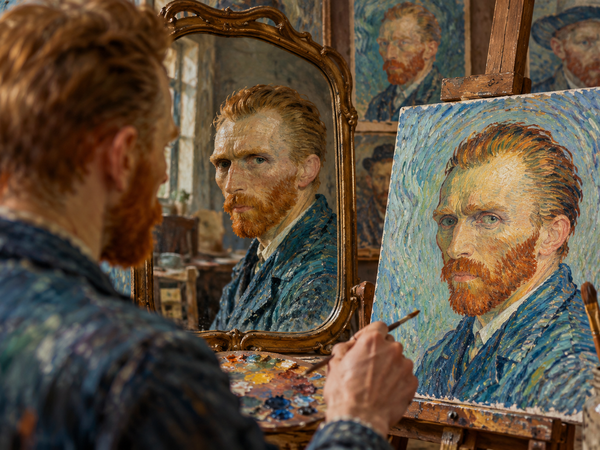
Vincent van Gogh is famous for his bold colors, expressive brushwork, and emotional paintings. Among his best-known works are his self-portraits. He painted himself repeatedly, using his own face as a convenient and fascinating subject. But his self-portraits were about more than simply recording his appearance.
Why Did Van Gogh Turn the Mirror on Himself?
One of the simplest reasons was availability. Van Gogh often had limited money and could not always afford to hire professional models. He always had access to himself, making a mirror an inexpensive solution.
Self-portraits also gave him complete control over the process. He could choose when to paint, change his pose, and experiment with different techniques without depending on another person.
How Many Self-Portraits Did Van Gogh Paint?
Van Gogh produced more than 30 self-portraits, most of them between 1886 and 1889. A large part of this work was created during his time in Paris, when his artistic approach was changing rapidly.
Some key facts about his self-portraits:
- More than 30 self-portraits are attributed to Van Gogh.
- 1886–1889 was the most productive period for these works.
- Paris played an important role in the development of his portrait style.
- He experimented with color, brushwork, light, and composition.
- The paintings range from relatively subdued works to highly expressive portraits.
Looking at these paintings in chronological order provides a clear picture of Van Gogh’s artistic development. The differences in color, technique, and composition show how quickly he experimented and moved toward his distinctive style.
Were Van Gogh’s Self-Portraits a Practical Choice?
Yes, practicality played an important role. Models cost money, and Van Gogh frequently struggled financially.
However, convenience alone does not explain the number of self-portraits he created. He also used them as a way to investigate painting itself. His face became a testing ground for new ideas about color, light, texture, and brushwork.
How Did Van Gogh Use Self-Portraits to Practice Art?
Self-portraits allowed Van Gogh to experiment without worrying about creating a perfect likeness.
He tried different approaches to:
- Color combinations
- Brushstroke patterns
- Facial expression
- Lighting and shadows
- Backgrounds
- Clothing and composition
His Paris self-portraits are especially important because they show his growing interest in brighter colors and more dynamic brushwork.
What Do Van Gogh’s Self-Portraits Reveal About His Style?
The paintings demonstrate that Van Gogh was not simply trying to reproduce his face realistically. He often transformed his appearance through color and energetic strokes.
His later portraits can feel almost animated because the paint itself becomes part of the subject. Thick, visible brushstrokes create movement around the face and clothing.
This approach helped establish the distinctive visual language associated with Van Gogh.
How Did His Self-Portraits Change Over Time?
an Gogh’s self-portraits changed noticeably as he developed as an artist. His earliest portraits were generally darker and more restrained, while his later works became brighter, more expressive, and more experimental. Each period reflects a different stage in his approach to color and brushwork.
Key changes in Van Gogh’s self-portraits:
- Early period: Darker colors, simple compositions, and more traditional brushwork.
- Paris period: Brighter colors and lighter tones influenced by contemporary artists.
- Experimentation: Increasing use of contrasting colors and visible, energetic brushstrokes.
- Later portraits: Stronger movement, vivid backgrounds, and more expressive use of paint.
- 1889: More dynamic strokes and intense color combinations became especially noticeable.
These changes make Van Gogh’s self-portraits more than a collection of images of the same person. Together, they show how his technique evolved from relatively traditional painting toward the distinctive, expressive style for which he became famous.
Did Van Gogh Use Self-Portraits to Explore His Identity?
Self-portraits can naturally become a form of self-examination, and Van Gogh’s paintings invite viewers to think about how he saw himself.
However, it is difficult to know exactly what he intended with every portrait. Not every self-portrait should be interpreted as a direct statement about his emotions or identity.
What is clearer is that Van Gogh repeatedly used his own image to explore appearance, artistic expression, and the possibilities of painting.
What Can We Learn From Van Gogh’s Different Self-Portraits?
Van Gogh’s self-portraits are valuable because they show his artistic development in a remarkably concentrated way. Instead of seeing a single style, viewers can follow his experiments with color, technique, and composition.
His repeated choice of himself as a subject also demonstrates that a familiar face can become a powerful artistic laboratory.
Ultimately, Van Gogh painted so many self-portraits because they combined practicality, artistic experimentation, and personal observation. His own face gave him a subject that was always available—and a way to continuously test how painting could communicate more than physical appearance.