Art has always been more than just visual beauty—it is a language of symbols, emotions, and coded messages. Many of the world’s most celebrated paintings contain layers of meaning that go beyond what meets the eye. From religious allegories to political commentary, artists have embedded hidden stories within their works, inviting viewers to look deeper. This article explores nine iconic paintings and the secret messages they carry, revealing how art can be both timeless and mysterious.
The Last Supper by Leonardo da Vinci
Leonardo da Vinci’s The Last Supper is one of the most analyzed paintings in history. At first glance, it depicts the biblical moment when Jesus announces that one of his disciples will betray him. Yet beneath the surface, scholars have uncovered intriguing details that suggest hidden symbolism.
Key symbolic elements include:
- Gestures of the disciples – Each reaction reflects their personality and role in the narrative.
- Positioning of Jesus – His central placement forms a triangle, symbolizing the Holy Trinity.
- Absence of a halo – Unlike traditional depictions, Jesus is shown without a halo, emphasizing his humanity.
- Use of perspective – Lines converge toward Jesus, reinforcing his spiritual importance.
- Possible musical code – Some researchers argue the arrangement of hands and bread resembles musical notes.
These details suggest that da Vinci intended the painting to be more than a religious scene—it is a coded exploration of faith, betrayal, and divine order. The work continues to inspire debates about hidden messages, including theories about Mary Magdalene’s presence and secret knowledge embedded in the composition.
The Arnolfini Portrait by Jan van Eyck
Jan van Eyck’s Arnolfini Portrait is often described as a simple marriage scene, yet its details reveal layers of symbolism. The painting shows a wealthy couple in a domestic setting, but nearly every object carries hidden meaning.
Symbolic details include:
- The dog – Represents loyalty and fidelity in marriage.
- The single candle in the chandelier – Symbolizes divine presence.
- The convex mirror – Reflects two additional figures, possibly witnesses or van Eyck himself.
- The woman’s green dress – Associated with fertility and hope.
- Fruit on the windowsill – Suggests wealth and abundance.
This painting is not just a portrait—it is a visual contract of marriage, filled with coded references to love, faith, and prosperity. Van Eyck’s mastery of detail makes the work a puzzle that continues to fascinate historians, who debate whether it depicts a wedding, a betrothal, or even a memorial.
The School of Athens by Raphael
Raphael’s The School of Athens is a grand fresco celebrating philosophy and knowledge. At first glance, it appears to be a gathering of ancient thinkers, but Raphael cleverly inserted hidden meanings.
Symbolic highlights include:
- Plato and Aristotle at the center – Representing idealism versus realism.
- Figures modeled after Renaissance contemporaries – Raphael included Michelangelo and Leonardo da Vinci disguised as philosophers.
- Architectural setting – Reflects classical harmony and Renaissance ideals.
- Gestures of the philosophers – Each pose conveys their intellectual approach.
- Self-portrait of Raphael – Subtly included among the crowd.
This fresco is more than a tribute to philosophy—it is Raphael’s statement about the unity of classical wisdom and Renaissance humanism. By blending ancient and modern figures, he symbolized the continuity of knowledge across time.
The Garden of Earthly Delights by Hieronymus Bosch
Bosch’s The Garden of Earthly Delights is one of the most enigmatic paintings ever created. Its triptych format shows paradise, earthly pleasures, and hell, but the imagery is filled with bizarre and symbolic details.
Hidden meanings include:
- Strange creatures – Represent human sins and temptations.
- Musical instruments in hell – Suggest punishment through earthly pleasures.
- Fruit and animals – Symbolize lust and excess.
- Central panel of indulgence – A warning against hedonism.
- Religious allegory – The entire work reflects humanity’s fall from grace.
Bosch’s surreal imagery has sparked centuries of interpretation, with some seeing it as a moral warning, while others view it as a fantastical exploration of human imagination. Its complexity makes it one of the most mysterious works in Western art.
The Night Watch by Rembrandt
Rembrandt’s The Night Watch is famous for its dramatic use of light and shadow, but it also contains hidden meanings about civic pride and leadership.
Symbolic elements include:
- Captain Frans Banning Cocq in light – Symbolizes authority and leadership.
- Figures in shadow – Represent ordinary citizens.
- The young girl with a chicken – A symbol of the militia’s emblem.
- Dynamic movement – Suggests unity and readiness for action.
- Contrast of light and dark – Reflects moral and social order.
This painting is not just a group portrait—it is a symbolic representation of Amsterdam’s civic guard. Rembrandt infused the work with allegory, turning a routine commission into a masterpiece of meaning and drama.
The Persistence of Memory by Salvador Dalí
Dalí’s The Persistence of Memory is instantly recognizable for its melting clocks, but its hidden meanings go far beyond surreal imagery.
Symbolic interpretations include:
- Melting clocks – Represent the fluidity of time and memory.
- Ants on a watch – Symbolize decay and mortality.
- Desolate landscape – Suggests emptiness and subconscious space.
- Organic shapes – Reflect dreamlike states.
- Self-portrait in distorted form – Dalí’s presence within the surreal world.
Dalí’s painting challenges the rigid concept of time, suggesting that memory and perception are unstable. It is both a philosophical statement and a surreal exploration of the subconscious.
Guernica by Pablo Picasso
Picasso’s Guernica is a monumental anti-war painting created in response to the bombing of Guernica during the Spanish Civil War. Its chaotic imagery is filled with symbolism.
Key symbols include:
- The bull – Represents brutality and darkness.
- The horse – Symbolizes suffering and the people of Spain.
- The broken sword – A sign of defeat and resistance.
- The light bulb – Suggests technological destruction.
- Weeping figures – Convey human tragedy.
This painting is not just a depiction of war—it is a universal cry against violence and oppression. Picasso used fragmented forms and stark contrasts to express the horror of conflict, making Guernica one of the most powerful political artworks ever created.
The Birth of Venus by Sandro Botticelli
Botticelli’s The Birth of Venus is a celebration of beauty and mythology, but it also carries hidden meanings about Renaissance ideals.
Symbolic details include:
- Venus on a shell – Represents divine beauty and purity.
- Zephyrs blowing wind – Symbolize spiritual inspiration.
- Flowers falling – Suggest fertility and renewal.
- Nude figure of Venus – Reflects classical ideals of harmony.
- Landscape background – Connects myth to earthly paradise.
This painting is more than a mythological scene—it is a statement about the rebirth of classical ideals during the Renaissance. Botticelli’s Venus embodies both physical beauty and spiritual perfection.
The Mona Lisa by Leonardo da Vinci
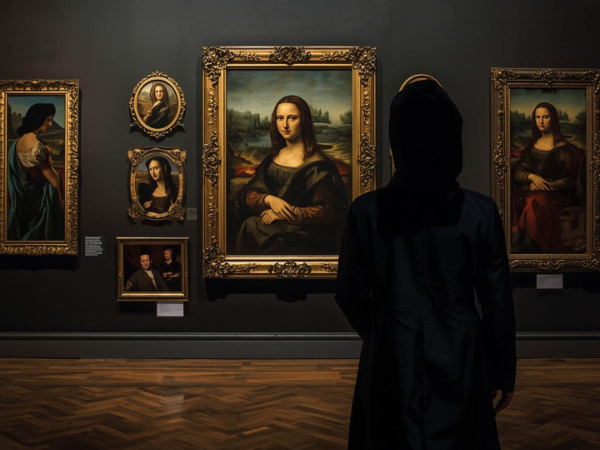
Perhaps the most famous painting in the world, da Vinci’s Mona Lisa is renowned for its mysterious smile, but it also contains hidden meanings.
Symbolic interpretations include:
- The smile – Represents ambiguity and psychological depth.
- The landscape background – Suggests harmony between humanity and nature.
- Use of sfumato technique – Creates a dreamlike atmosphere.
- Absence of jewelry – Highlights simplicity and inner beauty.
- Eyes that follow the viewer – Symbolize awareness and presence.
The Mona Lisa is not just a portrait—it is a psychological study, a philosophical statement, and a technical masterpiece. Its enduring mystery lies in the subtle interplay of expression, technique, and symbolism.