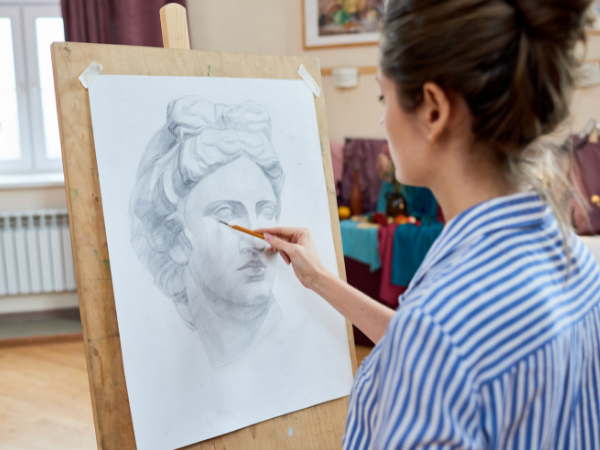
Drawing anatomy is one of the most essential skills for any artist who wants to create convincing and expressive human figures. It goes beyond simply copying what you see — it requires an understanding of how bones, muscles, and proportions interact to form the body’s structure and movement.
Understanding Human Proportions
When artists begin studying anatomy, one of the first challenges is mastering proportions. Human figures follow certain ratios that help maintain balance and realism. For example, the average adult body is about seven to eight heads tall, and the arms extend roughly to mid-thigh. These proportional guidelines give artists a framework to avoid distorted or awkward figures. By internalizing these measurements, artists can create figures that feel natural and believable.
- Head-to-body ratio – Standard measurement for overall height.
- Arm length – Extends to mid-thigh in most adults.
- Leg proportions – Legs are about half the body’s height.
- Torso balance – Should align with hips and shoulders.
- Hand size – Roughly the same length as the face.
By practicing these proportional rules, artists gain confidence in sketching figures that look anatomically correct. Over time, these guidelines become second nature, allowing for more expressive and dynamic poses without losing realism.
Studying Skeletal Structure
The skeleton is the foundation of human anatomy. Understanding bones helps artists visualize how the body supports itself and moves. The ribcage, pelvis, and spine are especially important because they define posture and balance. Without a grasp of skeletal structure, figures may appear stiff or unnatural.
- Skull structure – Guides facial proportions and head angles.
- Spine curvature – Essential for natural posture.
- Pelvis tilt – Influences leg placement and balance.
- Ribcage volume – Defines chest shape and breathing motion.
- Joint articulation – Determines range of movement.
By sketching simplified skeletons, artists can better understand how the body moves and rests. This knowledge allows them to create figures that feel grounded and realistic, even in dynamic action poses.
Muscles and Their Functions
Muscles give the body shape, strength, and movement. Artists must learn how muscles overlap and contract to depict realistic figures. For example, the deltoids define shoulder width, while the quadriceps shape the thighs. Recognizing these muscle groups helps artists avoid flat or lifeless drawings.
- Deltoid muscles – Shape the shoulders.
- Pectorals – Define chest volume.
- Quadriceps – Provide thigh strength and contour.
- Biceps and triceps – Control arm flexion and extension.
- Calves – Add definition to lower legs.
By studying muscle anatomy, artists can depict tension, relaxation, and movement more convincingly. This adds depth and realism to their work, making figures appear alive rather than static.
Gesture Drawing for Flow
Gesture drawing captures the essence of movement and energy. Instead of focusing on details, artists sketch quick, flowing lines to represent the body’s action. This practice helps avoid stiffness and builds confidence in drawing dynamic poses.
- Line of action – Central curve guiding body flow.
- Quick sketches – 30–60 second drawings for practice.
- Exaggeration – Enhances energy and motion.
- Weight distribution – Shows balance and grounding.
- Silhouette clarity – Ensures readable poses.
Gesture drawing trains the eye to see rhythm and balance in human figures. It’s a vital exercise for artists who want to capture life and movement in their work.
Studying Hands and Feet
Hands and feet are notoriously difficult to draw, yet they are crucial for expressive figures. Each contains complex bone and muscle structures that influence shape and movement. Artists must practice these parts to avoid awkward or unrealistic drawings.
- Finger proportions – Each finger has distinct length ratios.
- Palm structure – Defines hand flexibility.
- Foot arch – Essential for balance and walking.
- Toe alignment – Influences foot realism.
- Ankle articulation – Adds mobility to poses.
By dedicating time to hands and feet, artists elevate their figures from amateur to professional quality. These details bring personality and realism to every drawing.
Facial Anatomy and Expression
Faces are the most expressive part of the human figure. Understanding facial anatomy helps artists capture emotions and individuality. The skull, muscles, and skin all contribute to how expressions form.
- Eye placement – Positioned halfway down the head.
- Nose structure – Defines facial center.
- Mouth muscles – Control smiles and frowns.
- Eyebrow movement – Adds emotional nuance.
- Jawline definition – Shapes character identity.
By mastering facial anatomy, artists can create portraits that feel alive. Expressions become believable, adding depth to storytelling and character design.
Dynamic Poses and Motion
Dynamic poses bring energy to artwork. They show the body in action, whether running, jumping, or twisting. Artists must understand anatomy to depict these movements convincingly.
- Twisting torso – Adds motion to upper body.
- Running stance – Captures speed and balance.
- Leaping figures – Show explosive energy.
- Arm swings – Indicate rhythm and flow.
- Weight shifts – Ground figures in reality.
Dynamic poses challenge artists to balance anatomy with movement. Practicing these helps create illustrations that feel powerful and engaging.
Common Mistakes in Anatomy Drawing
Even experienced artists make mistakes when drawing anatomy. Recognizing these errors helps improve accuracy and style. Common issues include stiff poses, incorrect proportions, and ignoring muscle overlap.
- Stiff figures – Lack of gesture and flow.
- Proportion errors – Misaligned body ratios.
- Flat muscles – Ignoring depth and overlap.
- Misplaced joints – Leads to unnatural movement.
- Over-detailing – Distracts from overall form.
By identifying these mistakes, artists can refine their technique and produce more polished, professional work.
Practice Techniques for Improvement
Improvement in anatomy drawing comes from consistent practice. Artists should combine studies of proportions, skeletons, and muscles with gesture drawing and live observation.
- Life drawing sessions – Practice with real models.
- Anatomy books – Provide structured learning.
- Digital tools – Offer interactive references.
- Daily sketches – Build muscle memory.
- Pose references – Inspire dynamic drawings.
With dedication and structured practice, artists can steadily improve their anatomy skills. Over time, their figures will gain realism, energy, and expressive power.