A famous painting can look surprisingly different when you finally see it in a museum. The colors may seem softer, the details more impressive, or the artwork much larger or smaller than expected. This does not necessarily mean that photographs are inaccurate. Paintings are physical objects, and the way we experience them depends on light, distance, scale, framing, and even the condition of the surface.
Why Museum Lighting Changes the Way Paintings Look
Museum lighting is carefully controlled to protect artworks while also making them visible to visitors. The type, direction, and intensity of light can change how colors and textures appear.
A painting under soft gallery lighting may have subtle shadows and highlights that are difficult to see in a photograph. Light can also reveal the texture of brushstrokes, layers of paint, and areas of raised or cracked pigment.
Museums also avoid excessive exposure to strong light because it can gradually damage sensitive pigments. As a result, some galleries may appear darker than visitors expect.
How Seeing a Painting in Person Changes Your Perspective
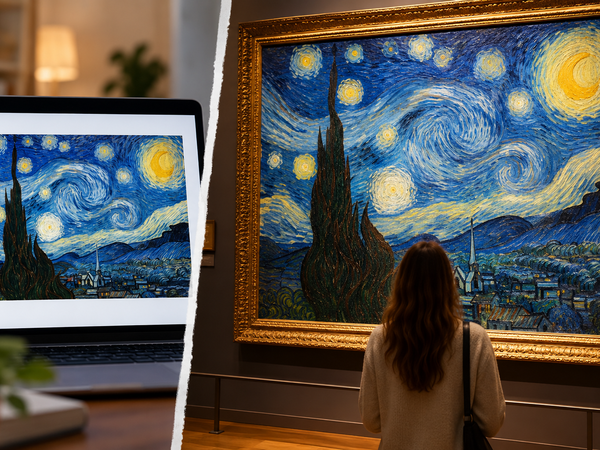
A photograph gives you a flat image on a screen, while a museum allows you to experience the actual physical artwork. You can move closer, step back, and view the surface from different angles.
In person, you may notice details that disappear in digital reproductions, such as tiny brushstrokes, changes in texture, or subtle transitions between colors.
Your surroundings also influence the experience. Standing in front of an original painting creates a sense of scale and physical presence that a small image on a phone or computer cannot reproduce.
Why Size Matters More Than You Expect
One of the biggest surprises can be the actual size of a painting. Online images rarely give viewers a reliable sense of scale.
A monumental canvas may look ordinary on a screen because the image is automatically resized. Conversely, a small painting can appear much larger when reproduced on a website.
| What you see online | What you may notice in a museum |
|---|---|
| Flat digital image | Physical surface and depth |
| Approximate visual size | True dimensions |
| Limited texture | Visible brushwork |
| Fixed viewing distance | Ability to move closer or farther away |
The real dimensions can completely change how a composition feels.
How Distance Affects the Details You Notice
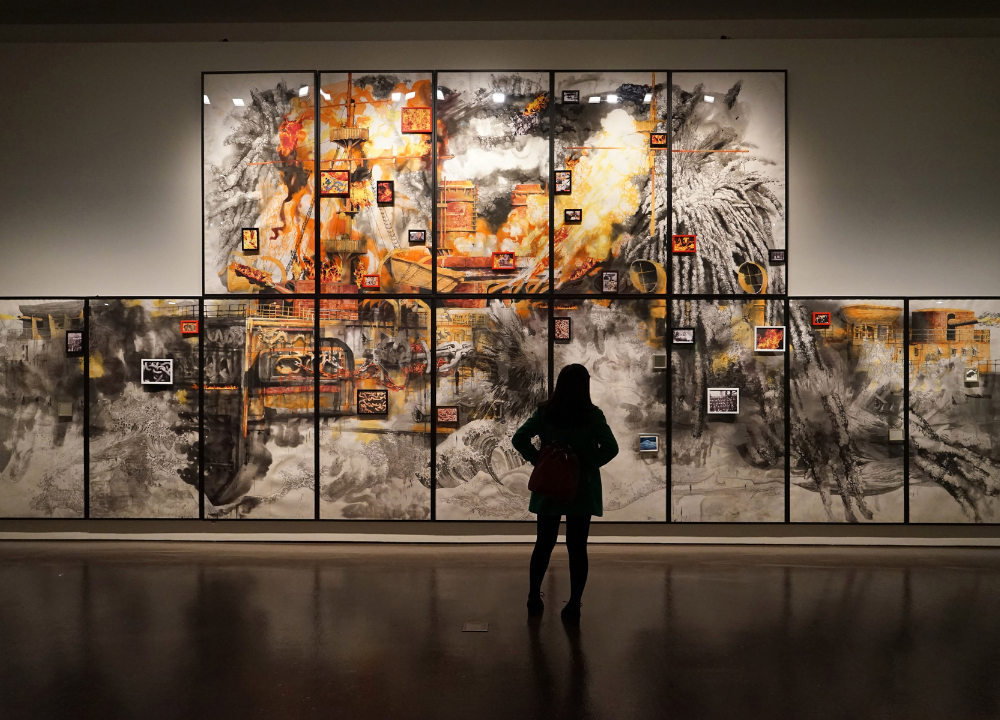
The distance between you and a painting can dramatically alter your perception. From across the room, individual brushstrokes may blend together and create smooth shapes or atmospheric effects.
When you move closer, the illusion can break apart. You may suddenly see short strokes, dots, scratches, or layers of different pigments.
This is especially interesting in paintings created with loose or impressionistic brushwork. From a distance, separate marks combine visually; up close, the technique becomes much more obvious.
Why Colors Can Look Different in Museum Galleries
Colors are affected by more than the pigments originally used by the artist. Lighting, aging, varnish, restoration, and surrounding colors can all influence how we perceive a painting.
A blue area, for example, can appear warmer or cooler depending on the light around it. A dark background may also make nearby colors seem brighter.
Digital photographs introduce another variable. Cameras, monitors, image compression, and screen settings can all affect color reproduction. Therefore, a photograph should not always be treated as an exact representation of the original colors.
How Varnish and Restoration Change Famous Paintings
Paintings can change over decades or centuries. Varnish may become yellow or darker with age, while pigments can fade or react to environmental conditions.
Conservators sometimes remove old varnish, repair damaged areas, or stabilize the surface. After conservation, a painting may look noticeably different from older photographs.
This does not mean the artwork has been changed arbitrarily. Conservation generally aims to preserve the painting and, where possible, reveal its original appearance while respecting the surviving historical material.
Some changes, however, cannot be completely reversed. The condition of an old painting is part of its history.
Why Photos Can Misrepresent a Painting’s True Appearance
Photographs are useful for studying and sharing art, but they cannot reproduce every aspect of an original painting.
A camera captures an image from one position and under specific lighting conditions. It cannot fully communicate the physical texture of the canvas, the thickness of the paint, or the way light interacts with the surface.
Common differences between photographs and originals include:
- Scale: the artwork may be much larger or smaller than expected.
- Texture: brushwork can disappear in a digital image.
- Color: screens and cameras can reproduce colors differently.
- Depth: a photograph reduces a three-dimensional surface to a flat image.
- Viewing distance: online images usually provide only one fixed perspective.
For this reason, seeing a famous painting in person can reveal qualities that are almost impossible to appreciate through reproduction alone.
Do Paintings Look Different Because of the Museum Display?
Yes, the presentation can influence how an artwork is perceived. The frame, wall color, lighting, viewing distance, and position within a gallery all contribute to the experience.
A painting displayed in a large room may feel different from the same work shown in a smaller gallery. A dark wall can make certain colors appear more prominent, while a brightly lit environment may emphasize surface details.
Museums therefore do more than simply hang paintings on walls. The surrounding environment is carefully considered because it can affect both visibility and interpretation.
Why Famous Paintings Can Surprise You in Person
The difference between a photograph and the real artwork comes from many factors working together: scale, lighting, color, texture, distance, conservation, and presentation.
That is why a painting you have seen hundreds of times online can still feel unfamiliar when you encounter it in a museum. The original is not just an image—it is a physical object with a surface, history, and presence.
Seeing a masterpiece in person does not necessarily make it “better” than its reproductions. Instead, it gives you access to visual information that photographs simply cannot capture.