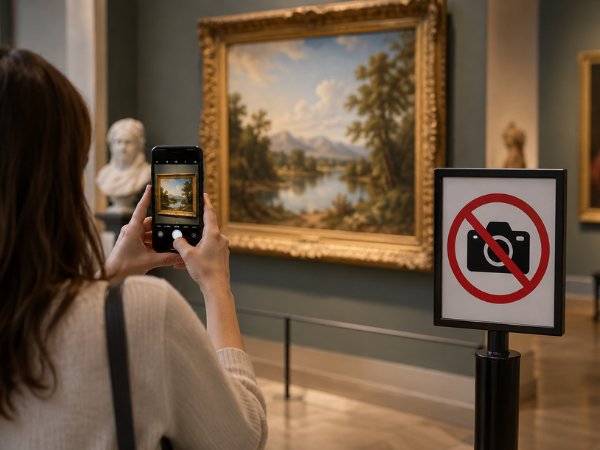
Taking photos in an art museum may seem harmless, especially when you want to remember a painting or share it with friends. However, many museums restrict or completely ban photography in certain galleries.
Photography policies are not the same everywhere. Some museums allow photos without flash, while others prohibit photography for particular exhibitions or individual artworks.
Why Do Some Art Museums Ban Photography?
Art museums may ban photography for several different reasons. The most common concern is protecting the artwork, but copyright, exhibition agreements, visitor comfort, and security can also influence museum rules.
| Reason | Why Photography May Be Restricted |
|---|---|
| Light exposure | Repeated exposure to strong light can affect sensitive materials |
| Fragile artworks | Some materials require additional protection |
| Copyright | Artists, lenders, or estates may control reproduction rights |
| Crowds | Photography can slow visitor movement |
| Visitor experience | Cameras can create distractions |
| Special exhibitions | Loan agreements may include photography restrictions |
A photography ban does not necessarily mean that every photograph could damage an artwork. In many cases, museums use restrictions as part of a broader conservation or exhibition policy.
Protecting Artwork From Flash and Light Exposure
Flash photography is one of the most recognizable reasons museums restrict cameras. A camera flash produces a short burst of intense light that can be problematic for particularly light-sensitive materials.
Paintings, drawings, manuscripts, textiles, photographs, and other works on paper can be more vulnerable to light than many modern materials.
For this reason, a museum may allow photography only when the flash is turned off. Other institutions may prohibit photography entirely when an exhibition contains especially sensitive objects.
Preventing Damage to Fragile Paintings and Artifacts
Not every artwork reacts to photography in the same way. Some objects are extremely delicate because of their age, materials, or previous conservation history.
For example, museums may take extra precautions with:
- Old manuscripts and books
- Watercolors and works on paper
- Historic textiles
- Early photographs
- Certain pigments and painted surfaces
- Fragile archaeological objects
In these situations, photography restrictions can be part of a larger conservation strategy designed to limit environmental stress and unnecessary risks.
Respecting Copyright and Reproduction Rights
Copyright is another reason why visitors may not be allowed to photograph certain artworks. A museum can display an artwork without necessarily owning all of the rights associated with reproducing its image.
Copyright or reproduction rights may belong to:
- The artist
- The artist’s estate
- A rights-management organization
- A private lender
- Another institution
This is particularly relevant for temporary exhibitions, contemporary art, and works borrowed from private collections.
A museum may therefore restrict photography even when there is no obvious conservation concern.
Keeping Galleries Quiet and Less Crowded
Photography can also affect how people move through a gallery. Visitors often stop for longer when taking several photos, checking their screens, or positioning themselves for a better angle.
This can create bottlenecks around popular artworks.
A photography policy can help museums maintain a smoother flow of visitors, especially in small galleries or heavily visited exhibitions.
Protecting the Visitor Experience
Museums are not only concerned with protecting objects. They also want visitors to be able to view art without constant distractions.
Phones and cameras can create problems when visitors:
- Hold devices in front of other people
- Use bright screens
- Take repeated photos
- Stop in the middle of busy walkways
- Use tripods or other equipment
Even when photography does not physically harm an artwork, it can change the atmosphere of a gallery.
Why Some Exhibitions Have Stricter Photography Rules
Photography rules can change from one exhibition to another. A museum might normally allow non-flash photography but introduce stricter rules for a temporary exhibition.
This can happen because an exhibition includes borrowed works, particularly fragile objects, or artworks subject to specific loan and reproduction conditions.
| Exhibition Type | Possible Photography Policy |
|---|---|
| Permanent collection | Photos may be allowed without flash |
| Temporary exhibition | Restrictions may be stricter |
| Fragile works | Photography may be prohibited |
| Private loans | Special restrictions may apply |
| Interactive installations | Rules may depend on the artist or exhibition |
This is why visitors should not assume that the same photography rules apply throughout an entire museum.
Can You Take Photos Without Flash in an Art Museum?
Sometimes, yes. Many museums distinguish between flash photography and photography without flash.
However, “no flash” does not always mean “photography allowed.” A sign at the entrance, gallery, or next to an individual artwork takes priority.
Before taking a picture, look for photography symbols or written instructions. If there is no clear information, asking a museum employee is the safest option.