The study of human anatomy has always been central to the development of realistic art. From ancient civilizations to the Renaissance, artists sought to understand the human body not only for aesthetic purposes but also to capture the essence of life itself. The journey of learning anatomy was often tied to science, philosophy, and religion, making it a fascinating intersection of disciplines. By examining bones, muscles, and proportions, artists gradually refined their ability to depict figures with accuracy and emotional depth. This article explores how artists learned anatomy, the role of dissection, and why proportions became essential to their craft.
The Early History of Anatomy in Art
In the earliest stages of art, human figures were symbolic rather than anatomically precise. Ancient Egyptian and Greek artists began experimenting with proportion, but their focus was often on idealized forms rather than scientific accuracy. Over time, curiosity about the body led to more detailed studies, especially in Greece, where philosophers and physicians influenced artistic practice.
- Egyptian Art – Figures were drawn in rigid, formulaic poses, emphasizing clarity over realism.
- Greek Sculpture – Artists like Polykleitos developed mathematical systems for proportion.
- Roman Influence – Roman artists adopted Greek ideals but added more naturalism.
- Medieval Art – Religious symbolism dominated, with less focus on anatomy.
- Transition to Renaissance – Renewed interest in classical texts sparked deeper anatomical study.
This early foundation set the stage for Renaissance breakthroughs, where art and science merged to elevate human representation beyond symbolism into realism.
How Renaissance Artists Studied the Human Body
During the Renaissance, artists became deeply invested in studying anatomy. They believed that understanding the body’s structure was essential for creating lifelike art. This period marked a shift from symbolic representation to scientific observation, with artists working alongside physicians to gain knowledge.
- Apprenticeships – Young artists learned anatomy through workshops and mentorship.
- Sketching from Life – Drawing live models became a standard practice.
- Classical Texts – Rediscovery of ancient writings guided anatomical studies.
- Collaboration with Scholars – Artists consulted physicians for accuracy.
- Experimentation – Continuous practice refined their skills in depicting movement.
By combining observation with theory, Renaissance artists elevated painting and sculpture, making the human body appear dynamic and natural rather than static and symbolic.
The Role of Dissection in Renaissance Art
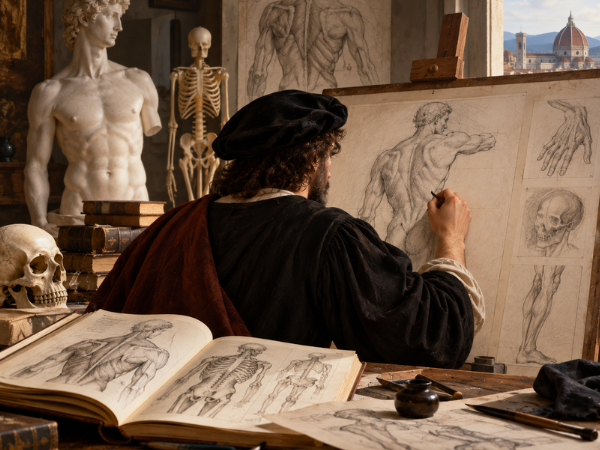
Dissection was a controversial yet transformative practice during the Renaissance. Despite religious restrictions, some artists gained access to cadavers, allowing them to study the body firsthand. This direct observation revolutionized their understanding of muscles, bones, and internal structures.
- Legal Restrictions – Dissection was often limited by church laws.
- Secret Studies – Some artists conducted dissections in private.
- Medical Collaboration – Physicians shared cadaver studies with artists.
- Detailed Sketches – Drawings captured the complexity of internal anatomy.
- Impact on Art – Paintings and sculptures became more anatomically precise.
Dissection bridged the gap between art and science, enabling artists to depict figures with unprecedented realism and emotional intensity.
How Artists Learned About Bones and Muscles
Bones and muscles were central to artistic anatomy. By studying the skeletal framework and muscular system, artists could depict movement, tension, and balance more effectively. This knowledge allowed them to portray figures in dynamic poses rather than rigid stances.
- Skeleton Studies – Artists examined bone structure for proportion.
- Muscle Mapping – Muscles were drawn layer by layer to understand function.
- Movement Analysis – Observing athletes and dancers informed depictions.
- Comparative Anatomy – Animal dissections provided additional insights.
- Artistic Application – Knowledge was applied to painting, sculpture, and drawing.
Mastery of bones and muscles gave artists the ability to capture not just physical accuracy but also the energy and vitality of human life.
Leonardo da Vinci and the Study of Human Anatomy
Leonardo da Vinci stands as the most iconic figure in the study of anatomy in art. His notebooks reveal a meticulous approach to dissecting and documenting the human body. He combined artistic skill with scientific curiosity, producing anatomical drawings that remain influential today.
- Dissection Records – Leonardo dissected numerous cadavers.
- Detailed Sketches – His drawings captured muscles, bones, and organs.
- Scientific Precision – He approached anatomy with the rigor of a scientist.
- Integration with Art – His anatomical studies informed masterpieces like Vitruvian Man.
- Legacy – His work influenced both artists and medical science.
Leonardo’s dedication to anatomy exemplifies how art and science can merge, creating knowledge that transcends disciplines.
How Anatomy Improved Renaissance Painting
The integration of anatomy into art transformed Renaissance painting. Artists could now depict figures with realistic proportions, depth, and movement. This shift elevated painting from symbolic storytelling to lifelike representation.
- Realistic Figures – Anatomy allowed for natural body shapes.
- Dynamic Poses – Knowledge of muscles enabled fluid movement.
- Emotional Expression – Accurate anatomy enhanced facial and bodily gestures.
- Perspective Integration – Anatomy worked alongside perspective for realism.
- Influence on Sculpture – Painters and sculptors shared anatomical insights.
Anatomy gave Renaissance art its distinctive realism, making works more relatable and emotionally powerful to viewers.
Why Human Proportions Were So Important to Artists
Human proportions were considered the foundation of beauty and harmony in art. Artists believed that mathematical ratios governed the ideal human form, and mastering these proportions was essential for achieving balance and realism.
- Vitruvian Principles – Based on Roman architect Vitruvius, proportions guided art.
- Symmetry and Balance – Artists emphasized harmony in body structure.
- Idealized Beauty – Proportions reflected cultural ideals of perfection.
- Mathematical Systems – Ratios were applied to both painting and sculpture.
- Universal Influence – Proportions shaped art across Europe.
By mastering proportions, artists could create figures that were not only anatomically accurate but also aesthetically pleasing, embodying the Renaissance pursuit of perfection.