Studying great artists is one of the most effective ways to grow as a creator. By analyzing their techniques, understanding their philosophies, and practicing their methods, you can accelerate your own artistic development. This article explores nine key approaches to learning from masters of art, each designed to help you refine your skills and discover your unique voice.
Understanding the Importance of Studying Masters
Learning from great artists is not about copying their work but about absorbing their wisdom. Every brushstroke, composition, and choice of color reflects years of practice and thought. By studying these elements, you gain insight into how art communicates emotion and meaning.
- Observe their techniques closely
- Analyze their use of light and shadow
- Study their compositions and balance
- Learn how they approached themes and symbolism
- Reflect on their creative process and discipline
When you engage with the works of masters, you begin to see patterns and principles that transcend time. This knowledge becomes a foundation upon which you can build your own style. By appreciating their struggles and triumphs, you also gain motivation to persist in your own journey.
Researching the Lives of Great Artists
Understanding an artist’s life provides context for their work. Their environment, challenges, and inspirations shaped their creations. By studying biographies and historical accounts, you uncover the human side of their genius.
- Read biographies and memoirs
- Explore letters and journals
- Study the cultural and political context
- Investigate their influences and mentors
- Examine their struggles and breakthroughs
This research helps you see art not as isolated masterpieces but as part of a larger narrative. Knowing that even great artists faced rejection and doubt can inspire resilience. Their personal stories remind us that art is both a reflection of life and a response to it.
Analyzing Techniques and Styles
Every artist develops a unique style through experimentation and refinement. By analyzing their techniques, you can learn practical skills to apply in your own work. This involves breaking down their methods and practicing them deliberately.
- Study brushwork and line quality
- Observe color palettes and blending methods
- Examine texture and layering techniques
- Analyze perspective and spatial depth
- Practice replicating small details
Through this analysis, you gain technical fluency. The goal is not imitation but understanding. Once you grasp how a technique works, you can adapt it to your own creative vision. This process sharpens your eye and hand simultaneously.
Visiting Museums and Galleries
Experiencing art in person offers insights that reproductions cannot capture. The scale, texture, and presence of original works reveal subtleties that deepen your appreciation and understanding.
- Visit local museums regularly
- Attend special exhibitions
- Observe artworks from different angles
- Compare works across periods and styles
- Take notes and sketch during visits
Museums and galleries provide a direct connection to history. Standing before a masterpiece allows you to feel its impact as intended. This immersive experience strengthens your ability to interpret and respond to art emotionally and intellectually.
Practicing Master Studies
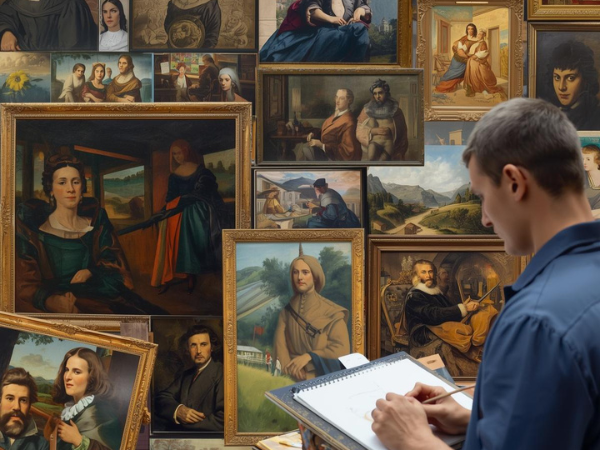
A master study involves recreating an artwork to understand its construction. This exercise trains your hand and eye while teaching you discipline and patience.
- Select a piece that inspires you
- Recreate it carefully, step by step
- Focus on composition and proportion
- Pay attention to color and texture
- Reflect on the process afterward
Master studies are not about producing perfect copies but about learning through practice. Each attempt reveals new insights into technique and decision-making. Over time, these exercises build confidence and skill that transfer to your original work.
Learning from Different Art Movements
Art movements reflect shifts in culture, philosophy, and technique. Studying them broadens your perspective and exposes you to diverse approaches.
- Explore Renaissance realism
- Study Impressionist light and color
- Analyze Cubist abstraction
- Examine Surrealist symbolism
- Understand Modernist experimentation
Each movement offers lessons in innovation and adaptation. By learning from multiple styles, you avoid becoming narrow in your approach. This diversity enriches your own creativity and helps you develop a flexible artistic mindset.
Applying Lessons to Your Own Work
The ultimate goal of studying great artists is to improve your own art. Applying lessons requires conscious practice and reflection. You must integrate what you learn into your personal style.
- Experiment with new techniques
- Incorporate compositional principles
- Adapt color schemes to your themes
- Reflect on emotional impact
- Refine your process continuously
Application transforms knowledge into skill. By blending inspiration with originality, you create art that is both informed and authentic. This balance ensures that your work grows while remaining true to your vision.
Developing Critical Thinking in Art
Critical thinking allows you to evaluate art beyond surface impressions. It involves questioning choices, interpreting meaning, and considering context. This skill sharpens your ability to learn from others and improve yourself.
- Ask why an artist made certain choices
- Consider cultural and historical influences
- Evaluate technical execution
- Reflect on emotional resonance
- Compare interpretations with others
Critical thinking deepens your engagement with art. It helps you move from passive admiration to active learning. By questioning and analyzing, you develop a sharper artistic mind that guides your own creative decisions.
Building Your Unique Artistic Voice
While studying great artists is essential, your ultimate goal is to develop your own voice. This requires synthesizing lessons while embracing individuality. Your art should reflect your experiences, emotions, and ideas.
- Identify what inspires you most
- Experiment with combining techniques
- Develop consistent themes and motifs
- Embrace imperfections as part of style
- Share your work and seek feedback
Building a unique voice takes time and courage. It means honoring tradition while daring to innovate. By learning from the masters and then stepping beyond them, you create art that is truly yours—authentic, expressive, and impactful.