Art has the power to transcend time, culture, and geography. Some paintings are so iconic that they feel familiar even to those who have never studied art history. Yet behind every brushstroke lies a story—of the artist, the era, and the emotions captured on canvas. This article explores nine masterpieces, each with its own fascinating tale, revealing the hidden layers that make them unforgettable.
The Mona Lisa by Leonardo da Vinci
Leonardo da Vinci’s Mona Lisa is perhaps the most recognized painting in the world. Painted in the early 16th century, it continues to captivate audiences with its enigmatic smile and mysterious aura. Scholars debate whether the subject is Lisa Gherardini, a Florentine woman, or a symbolic representation of ideal beauty. The painting’s fame skyrocketed after it was stolen from the Louvre in 1911, cementing its place in popular culture.
Key details that define its story:
- Painted between 1503–1506, possibly later refined.
- Subject believed to be Lisa Gherardini, wife of a Florentine merchant.
- Famous for its sfumato technique, blending tones seamlessly.
- Stolen in 1911, recovered two years later.
- Today, displayed behind bulletproof glass in the Louvre.
The Mona Lisa is more than a portrait—it is a cultural phenomenon. Its subtle expression invites endless interpretation, making it a timeless puzzle for art lovers and historians alike. The painting’s journey from Renaissance Italy to modern celebrity status is itself a story of intrigue and fascination.
The Starry Night by Vincent van Gogh
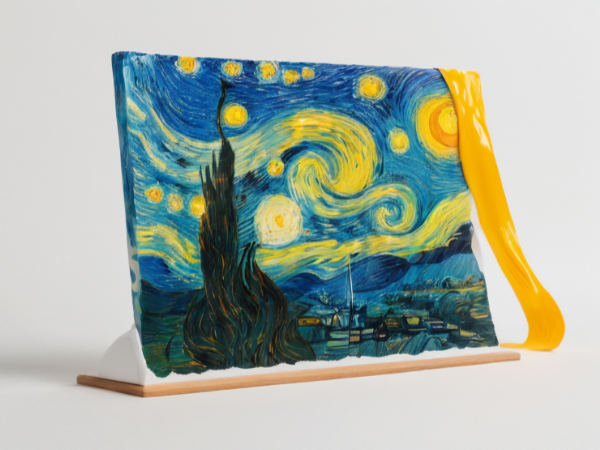
Vincent van Gogh’s The Starry Night is a swirling vision of the night sky, painted in 1889 while he was in an asylum in Saint-Rémy-de-Provence. The work reflects both his inner turmoil and his awe of nature’s grandeur. The bold brushstrokes and vivid blues create a sense of movement that feels alive, almost cosmic.
Elements that shape its narrative:
- Painted from memory, not direct observation.
- Combines imagination with real village structures.
- Symbolizes van Gogh’s struggle with mental health.
- Features a cypress tree, often linked to death and eternity.
- Now housed in the Museum of Modern Art, New York.
The painting’s emotional intensity mirrors van Gogh’s own life—marked by passion, instability, and genius. The Starry Night is not just a depiction of the sky; it is a window into the artist’s soul, capturing both chaos and beauty in a single frame. Its resonance continues to inspire artists, musicians, and dreamers worldwide.
The Persistence of Memory by Salvador Dalí
Salvador Dalí’s The Persistence of Memory (1931) is instantly recognizable for its melting clocks. This surrealist masterpiece challenges conventional ideas of time and reality. Dalí was influenced by Freudian theories of the subconscious, and the painting reflects dreamlike distortions that defy logic.
Highlights of its surreal symbolism:
- Painted in 1931 during the Surrealist movement.
- Melting clocks symbolize fluidity of time.
- Ants represent decay and impermanence.
- Landscape inspired by Dalí’s native Catalonia.
- Displayed at the Museum of Modern Art, New York.
Dalí’s work invites viewers to question reality itself. The painting’s dreamlike imagery suggests that time is not rigid but subjective, shaped by perception and memory. Its bizarre yet captivating visuals make it one of the most iconic surrealist works ever created, embodying the strange beauty of the subconscious mind.
The Last Supper by Leonardo da Vinci
Leonardo da Vinci’s The Last Supper (1495–1498) is a monumental fresco capturing the moment Jesus announces that one disciple will betray him. The painting is celebrated for its composition, emotional depth, and innovative use of perspective.
Key aspects of its significance:
- Painted in Milan’s Santa Maria delle Grazie convent.
- Depicts the dramatic reaction of the disciples.
- Innovative use of linear perspective draws focus to Christ.
- Fragile condition due to experimental technique.
- Subject of countless restorations and reproductions.
The Last Supper is not just a religious image—it is a study of human emotion. Each disciple reacts differently, reflecting shock, denial, or confusion. Leonardo’s mastery of psychology and perspective makes this painting a cornerstone of Renaissance art, bridging faith and human drama in a single scene.
The Birth of Venus by Sandro Botticelli
Sandro Botticelli’s The Birth of Venus (1480s) depicts the goddess Venus emerging from the sea on a shell, symbolizing beauty and divine love. Commissioned by the Medici family, the painting embodies Renaissance ideals of harmony and mythological revival.
Defining features of its mythological charm:
- Inspired by classical mythology and poetry.
- Venus symbolizes purity, love, and divine beauty.
- Painted with tempera on canvas, unusual for the time.
- Commissioned by the influential Medici family.
- Displayed in the Uffizi Gallery, Florence.
The painting’s graceful lines and soft colors evoke a sense of ethereal beauty. Botticelli’s Venus became an enduring symbol of Renaissance humanism, blending pagan mythology with Christian ideals. Its influence extends beyond art, shaping fashion, literature, and modern visual culture.
Guernica by Pablo Picasso
Pablo Picasso’s Guernica (1937) is a powerful anti-war statement, created in response to the bombing of the Basque town during the Spanish Civil War. The monochromatic palette and fragmented figures convey chaos, suffering, and destruction.
Elements that define its protest:
- Painted in 1937 after Guernica’s bombing.
- Monochrome palette emphasizes stark brutality.
- Figures symbolize pain, death, and resilience.
- Commissioned for the Paris International Exposition.
- Now housed in the Museo Reina Sofía, Madrid.
Guernica transcends its historical moment, becoming a universal symbol of the horrors of war. Picasso’s fragmented style mirrors the disintegration of humanity under violence. The painting continues to resonate as a reminder of the devastating impact of conflict and the enduring call for peace.
The Girl with a Pearl Earring by Johannes Vermeer
Johannes Vermeer’s Girl with a Pearl Earring (1665) is often called the “Mona Lisa of the North.” The painting portrays a young woman in exotic dress, her gaze both intimate and mysterious. The pearl earring serves as the focal point, symbolizing purity and wealth.
Notable aspects of its allure:
- Painted around 1665 in Delft, Netherlands.
- Subject remains unidentified, adding mystery.
- Masterful use of light and shadow.
- Turban reflects fascination with exotic fashion.
- Displayed in the Mauritshuis, The Hague.
The painting’s simplicity belies its depth. Vermeer’s use of light creates a lifelike presence, making the girl appear timeless. The mystery of her identity adds intrigue, ensuring the painting’s enduring appeal across centuries and cultures.
The Night Watch by Rembrandt van Rijn
Rembrandt’s The Night Watch (1642) is a dynamic group portrait of a militia company. Unlike traditional static portraits, Rembrandt infused movement and drama, making the scene feel alive. The painting’s title is misleading—it actually depicts a daytime setting darkened by varnish.
Distinctive features of its innovation:
- Painted in 1642 for Amsterdam’s civic guard.
- Depicts Captain Frans Banning Cocq and his company.
- Revolutionary use of light and shadow.
- Large-scale canvas measuring over 12 feet wide.
- Displayed in the Rijksmuseum, Amsterdam.
Rembrandt’s bold composition broke conventions, transforming a civic portrait into a dramatic narrative. The painting’s scale and energy reflect the pride of Amsterdam’s citizens, while its artistry showcases Rembrandt’s genius in capturing collective identity and motion.
American Gothic by Grant Wood
Grant Wood’s American Gothic (1930) is an iconic depiction of rural America during the Great Depression. Featuring a stern farmer and his daughter (often mistaken for his wife), the painting symbolizes resilience and traditional values.
Key elements of its cultural resonance:
- Painted in 1930 during the Great Depression.
- Models were Wood’s sister and dentist.
- Gothic-style farmhouse inspired the title.
- Interpreted as satire or celebration of rural life.
- Displayed at the Art Institute of Chicago.
The painting’s ambiguity invites multiple interpretations. Some see it as a critique of rigid Midwestern values, while others view it as a tribute to perseverance. Its enduring popularity lies in its ability to reflect both irony and admiration, making it a quintessential piece of American art history.
Conclusion
These nine paintings are more than images—they are stories etched into canvas, each carrying layers of meaning, history, and emotion. From da Vinci’s enigmatic Mona Lisa to Picasso’s haunting Guernica, they remind us that art is not static but alive, constantly reshaped by interpretation and context. By uncovering their stories, we deepen our appreciation for the masterpieces that continue to shape our cultural imagination.